The Hermit
The Magus of the Voice of Light, Prophet of the Eternal
- Arcana
- Major Arcana, card 9
- Element
- Earth
- Hebrew letter
- Yod (י)
- Zodiac
- Virgo
- Sephirah
- Chesed to Tiphareth
- Path
- 20th Path on the Tree of Life
- Alchemical stage
- Fermentation
The Scene on the Card
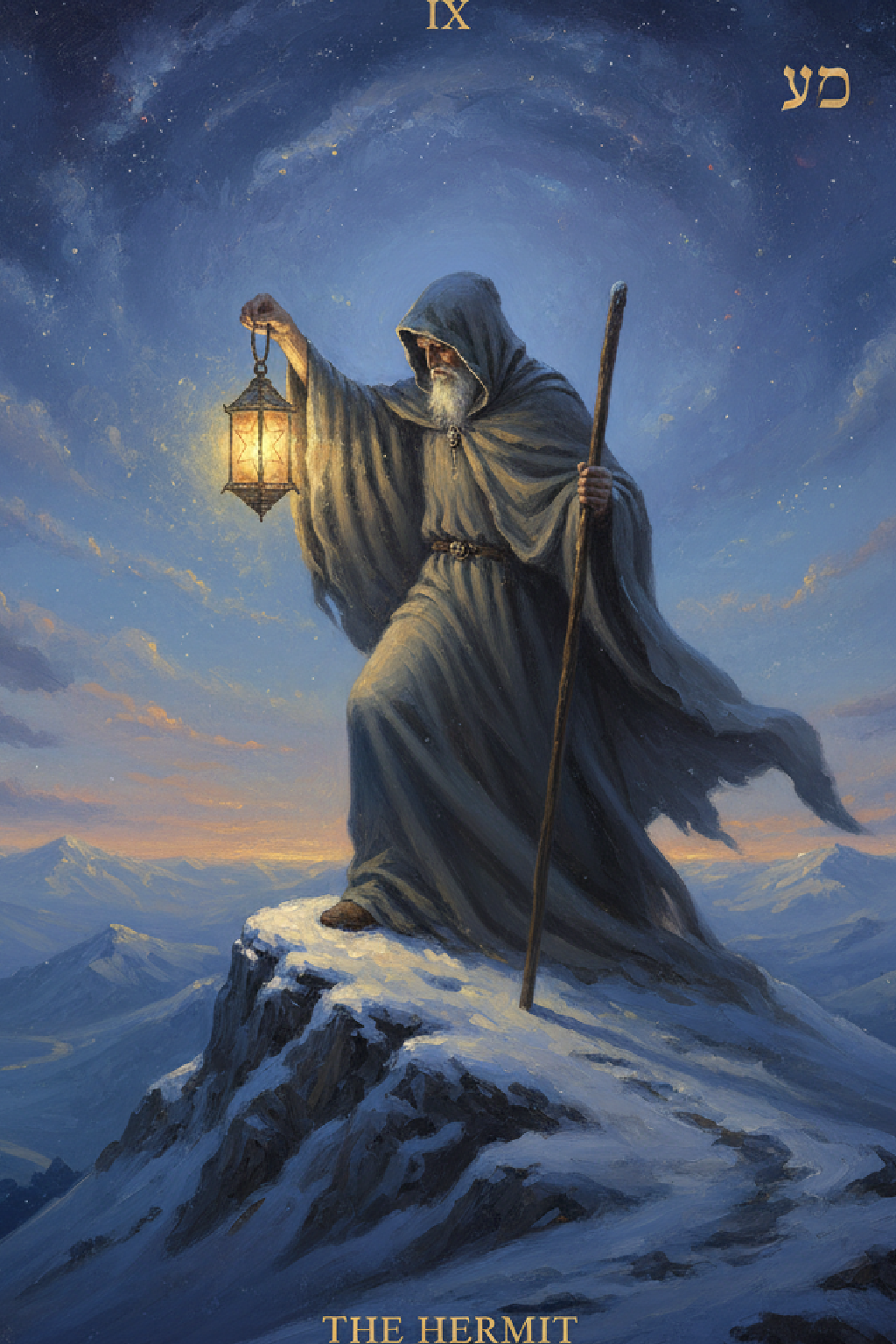
The card shows an old man in a grey hooded robe on a snowy summit, a lantern raised with a six-pointed star inside it, staff in his other hand, looking down toward the valley.
Upright Meaning
When The Hermit appears upright, you are called to withdrawal, solitude, and inner work. This is not escape but purposeful retreat - going within to find what cannot be found outside. The answers you seek are already within you; silence is required to hear them.
In practical terms, this card indicates a need for time alone, study and reflection, consultation with a mentor or guide, or becoming such a guide for others. Take a break from social engagement. Reduce stimulation. Create space for wisdom to emerge.
The Virgo influence brings analytical precision to the spiritual quest. Don't just feel your way - think carefully, discriminate clearly, examine assumptions. The Hermit's lamp is reason illuminating intuition.
Esoterically, The Hermit often indicates an encounter with a teacher - internal or external - who embodies the path you are walking. The teacher may appear as a person, a book, a dream, or an inner voice. Recognize and honor the guidance offered.
This card asks: What requires solitary attention in your life? What inner work have you been avoiding through busyness? What light do you carry that others need?
Reversed and Shadow Meaning
The Hermit reversed reveals distortions of solitude, wisdom, and guidance.
Isolation as defense: using withdrawal to avoid relationship, challenge, or growth. Solitude that is not generative but merely lonely. The cave that becomes a prison.
Spiritual pride: believing one's attainment makes one superior. The guru trap - identifying with the role of wise one. The light that blinds rather than illuminates.
Refusal of guidance: insisting on learning everything alone, rejecting offered wisdom, inability to be a student. Pride masquerading as independence.
Premature teaching: offering guidance before one has genuinely attained, leading others astray through well-meaning ignorance. The blind leading the blind.
Paralysis of analysis: Virgo's discrimination becoming endless criticism, the lamp turned into a searchlight that finds only flaws. Analysis that never synthesizes.
Avoiding solitude: fear of being alone with oneself, constant distraction, inability to sit in silence. Running from the inner work.
Golden Dawn shadow: the 20th Path blocked - Mercy cannot reach Beauty. Divine love cannot focus into personal illumination. Expansion without concentration.
Ask yourself: Is my solitude serving growth or avoiding life? Am I genuinely wise or merely playing the part? What guidance am I refusing to receive?
Esoteric Foundations
The Hermit is Yod, the smallest Hebrew letter yet the seed of all others - every letter begins with Yod. It represents the concentrated essence, the point from which manifestation extends. The 20th Path connects Chesed (Mercy) to Tiphareth (Beauty), bringing expansive divine love into focused inner illumination.
In Crowley's Thoth deck, The Hermit stands wrapped in red (life force contained within), holding a lantern bearing a sun (not merely reflecting light but generating it). Before him is the serpent of wisdom, Orphic egg, and the three-headed dog Cerberus representing the transformed instincts. Wheat stalks indicate the harvest of solitary cultivation.
In the Rider-Waite-Smith deck, an aged figure in grey robes stands on a snowy mountain peak, staff in one hand, lantern in the other. The lantern contains a six-pointed star - the integration of masculine and feminine, fire and water. He illuminates the path for those who follow.
Both decks portray the one who has gone ahead, done the work in solitude, and now carries the light of attainment for others.
Symbols and Forces
The Hermit embodies the Hermetic Principle of Correspondence internalized - "As within, so without." Rather than acting on the outer world, The Hermit works on the inner world, knowing that internal transformation eventually manifests externally. This is the Great Work conducted in secret, in solitude, in silence.
Virgo rules this card - the Virgin, ruled by Mercury. Virgo is the harvest, the discrimination of wheat from chaff, the careful analysis that separates essential from accidental. The Hermit's lamp is this discriminating intelligence, seeing clearly through the darkness of confusion.
In alchemy, The Hermit corresponds to fermentation - the stage where the purified matter is left alone to undergo internal transformation. Like wine or bread, the prima materia must be sealed away from interference, allowed to change through its own process. The alchemist waits.
Psychologically, The Hermit represents the individuated Self - the ego that has recognized the larger psyche and now serves as its conscious agent. Solitude is not loneliness but the removal of distraction so the inner work can proceed.
Yod as "hand" indicates that The Hermit works with precision and skill - this is not passive withdrawal but active inner cultivation. The hand that holds the lantern is steady from practice.
Myth and Context
The Hermit appears throughout tradition as the wise elder who dwells apart. In Greek mythology, Chiron the centaur (wounded healer, teacher of heroes) represents this archetype. In the Grail legends, the Fisher King waits in solitude for the one who will ask the right question.
Saturn and Chronos connect to The Hermit - Father Time who has seen everything, whose age is not weakness but accumulated wisdom. The scythe that reaps also clears away what has been completed.
In the Tarot's structure, The Hermit occupies card IX, completing the first series of initiation. Having passed through the gates of The High Priestess and conquered with The Chariot, the seeker must now integrate in solitude before the new cycle (Wheel of Fortune) begins.
Diogenes with his lantern, seeking one honest man, embodies The Hermit's search for truth in a world of illusion. His lantern is not to see by but to reveal - to test what claims to be real.
The mountain peak represents the high places where prophets receive revelation - Moses on Sinai, Zarathustra's mountain, the hermit caves of Christian, Buddhist, and Hindu traditions. Height brings perspective; solitude brings clarity.
Integration Practice
To integrate The Hermit, create genuine solitude. Schedule regular time completely alone - no phone, no media, no distraction. Start with an hour, extend to a day, eventually to a retreat.
Journaling prompt: "What am I avoiding by staying busy? What would I hear if I became still? What wisdom is waiting in my solitude?"
Ritual practice: Light a single candle in darkness. Sit with it. Let it represent your own inner light. Ask: What does this light illuminate when I remove external noise?
Mentorship: Either seek a mentor/teacher/guide for your current phase, or recognize where you are called to mentor others. The Hermit both receives and gives guidance.
Study practice: Choose one text of wisdom and study it deeply rather than reading many things superficially. Let one book be your companion for a month. Take notes. Reread. Contemplate.
Embodied practice: Walking meditation in nature, preferably alone and in silence. Let the body move while the mind settles. Let landscape teach without words.
Analysis exercise: Take one problem or question and analyze it thoroughly in writing. Define terms. Examine assumptions. Look at all sides. Let Virgo's precision serve wisdom.
Ask your own question
Readings, sound healing and the sacred calendar await in the Ouracle sanctuary. Free for 14 days.
Draw a tarot spread