Fortune
The Lord of the Forces of Life
- Arcana
- Major Arcana, card 10
- Element
- Fire
- Hebrew letter
- Kaph (כ)
- Planet
- Jupiter
- Sephirah
- Chesed to Netzach
- Path
- 21st Path on the Tree of Life
- Alchemical stage
- Rotation of the Elements
The Scene on the Card
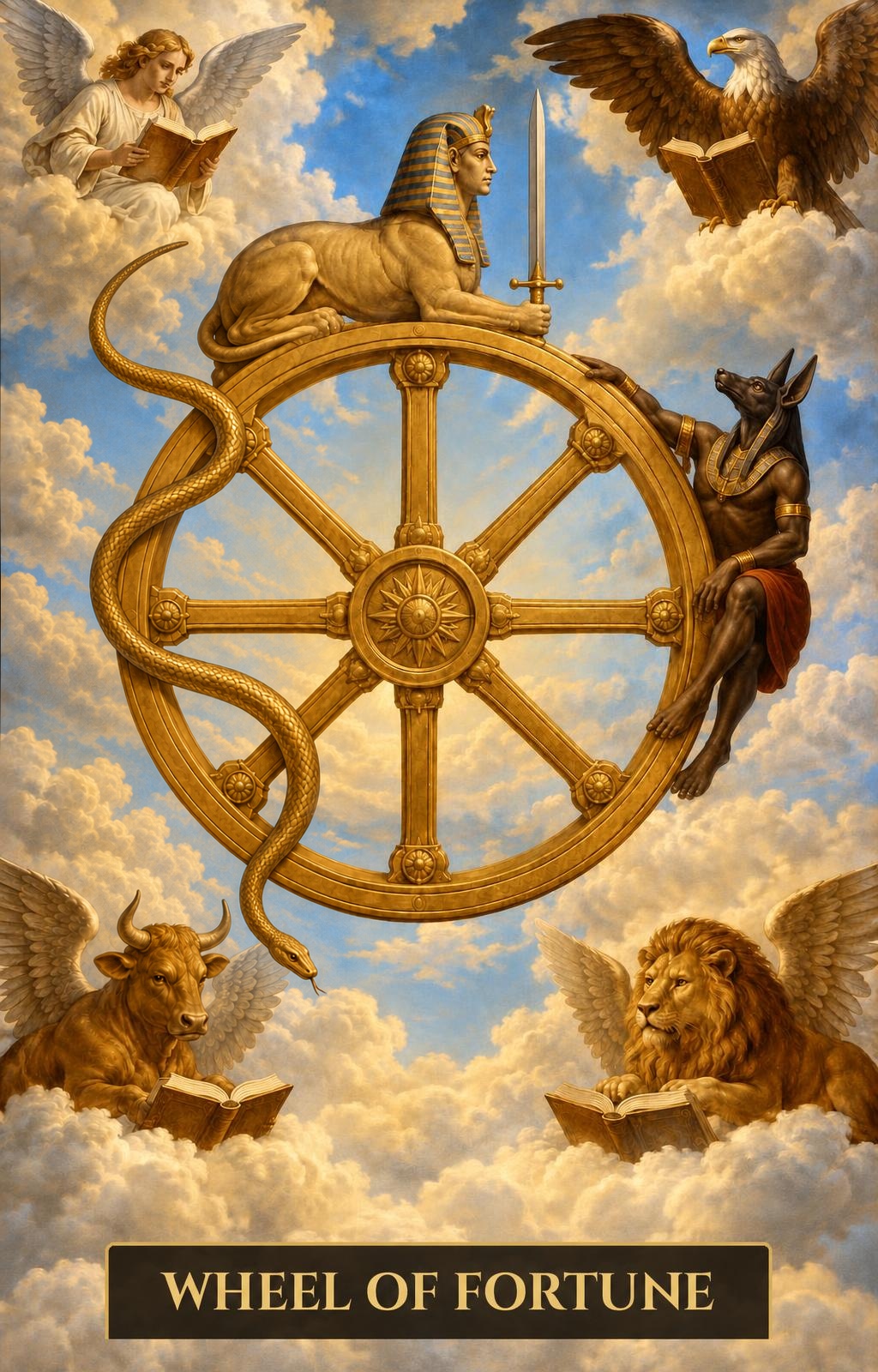
The card shows a great golden wheel turning in a clear sky, a sphinx with a sword seated on top, a jackal-headed figure rising on one side and a serpent descending on the other, with an angel, eagle, bull and lion reading books on clouds in the four corners.
Upright Meaning
When Fortune appears upright, forces are in motion that will bring change - usually for the better, as Jupiter is the greater benefic. Luck, opportunity, expansion, and positive shifts are indicated. But remember: the wheel keeps turning.
In practical terms, this card indicates a change in circumstances, often sudden. Gambles may pay off. Opportunities arrive. What was stuck begins to move. Take advantage of the upswing while remaining aware that cycles continue.
The Jupiter influence brings optimism, generosity, and philosophical perspective. See the larger pattern. Trust the process. Even if this moment is difficult, the wheel will turn.
Esoterically, Fortune often indicates karmic completion - cycles resolving, patterns completing, new cycles beginning. What you have set in motion reaches fruition. New causes are initiated.
This card asks: Where am I in the cycle? Am I rising or falling? How can I work with current momentum rather than against it? What wants to change?
Reversed and Shadow Meaning
Fortune reversed reveals distortions of chance, cycle, and change.
Stagnation: the wheel stuck, refusing to turn. Circumstances that should change remain frozen. Resistance to inevitable transition.
Bad luck: the downswing of the cycle experienced as unfair persecution. "Why me?" without recognition of cyclical nature. Victim consciousness.
Gambling unwisely: trying to force luck, taking reckless risks on the assumption that fortune will favor you. Magical thinking about probability.
Resisting change: clinging to the top of the wheel, refusing to accept that descent is natural and necessary. Grasping what cannot be held.
Fatalism: using "it's fate" as excuse for passivity. The wheel turns, but we can choose our response to its turning.
Wheel spinning: change without development, movement without progress. Repetition of cycles that should have been completed.
Golden Dawn shadow: the 21st Path blocked - Mercy cannot reach Victory. Expansion cannot manifest in actual achievement. Fortune that never materializes.
Ask yourself: Am I fighting the current cycle or flowing with it? What is trying to change that I'm resisting? Where am I gambling foolishly?
Esoteric Foundations
The Wheel of Fortune is Kaph, the palm of the hand that receives and releases. What we grasp cannot be held forever; what we release returns in new form. The 21st Path connects Chesed (Mercy/Jupiter) to Netzach (Victory/Venus), bringing expansive fortune into the realm of desire and passion.
In Crowley's Thoth deck, the Wheel is set against a starry void with ten spokes (the Sephiroth). Three figures ride the wheel: a sword-wielding sphinx at the top (consciousness arrived at zenith), the typhonic ape Hermanubis ascending (animal nature rising toward consciousness), and the crocodile Typhon-Set descending (old form dissolving). Lightning bolts energize the rotation.
In the Rider-Waite-Smith deck, a similar arrangement appears with clearer symbology: the Hebrew letters YHVH and TARO (or ROTA, Latin for wheel) spell both the divine name and the word for law. The four living creatures of Ezekiel's vision hold books in the corners, representing the fixed signs of the zodiac.
Both decks portray the inexorable rotation of manifestation - rising and falling, creation and destruction, the pulsation of cosmic life.
Symbols and Forces
Fortune embodies the Hermetic Principle of Rhythm - "Everything flows, out and in; everything has its tides; all things rise and fall." The pendulum swing manifest in all existence. Day follows night, summer follows winter, prosperity follows hardship and hardship prosperity. The wise work with these rhythms rather than against them.
Jupiter rules this card - Zeus, the expansive father god of abundance and opportunity. Jupiter represents the forces of growth, luck, and expansion. But Jupiter also rules excess - too much of a good thing becomes problematic. Fortune reminds us that "more" is not always better.
In alchemy, the Wheel represents the rotation of elements required for the Work - fire to earth to air to water and around again. Each element must have its turn, its dominance, its recession. The alchemist cannot skip stages or freeze the wheel.
Psychologically, Fortune represents the recognition that the ego is not in control - that larger forces move through our lives, raising and lowering us according to patterns we can observe but not command. This is not fatalism but realistic humility.
The palm (Kaph) grasps - but what the palm grasps today, it releases tomorrow. The Wheel teaches non-attachment through direct experience of impermanence.
Myth and Context
Fortuna, the Roman goddess of fate, spins the wheel that raises and lowers mortals. Her Greek counterpart Tyche personifies luck - both good and bad. In medieval imagery, figures cling to Fortuna's wheel: "Regnabo" (I shall reign), "Regno" (I reign), "Regnavi" (I have reigned), "Sum sine regno" (I am without reign).
The Buddhist wheel of dharma represents the turning of cosmic law and the cycles of samsara. The eight spokes correspond to the Noble Eightfold Path - the way to step off the wheel of suffering.
In the Tarot's structure, Fortune (X) begins the second cycle of Major Arcana. The initiate has completed the first phase (Fool through Hermit) and now faces the collective forces that shape individual destiny.
The three figures on the wheel correspond to the gunas of Hindu philosophy: sattva (sphinx at top - equilibrium/consciousness), rajas (ascending ape - activity/passion), tamas (descending serpent - inertia/dissolution). All three are always present; what changes is which dominates.
The Rota Fortunae (Wheel of Fortune) was a central motif of medieval thought - the recognition that worldly position is impermanent, that kings become beggars and beggars kings.
Integration Practice
To integrate Fortune, study your own cycles. What patterns repeat in your life? Where are you in current cycles? Keep a journal tracking ups and downs over months.
Journaling prompt: "What cycle is currently turning in my life? What is ascending? What is descending? How can I cooperate with this movement?"
Ritual practice: Create or draw a wheel divided into the cycles that affect your life - seasons, months, weekly rhythms, personal patterns. Mark where you are now. Notice what's approaching.
Gratitude practice: When fortune favors, express gratitude without attachment. When fortune withdraws, express gratitude for what was received. Both attitudes prepare you for the wheel's turning.
Embodied practice: Spinning meditation - turn slowly with arms extended, experiencing the wheel's motion in your body. Notice how stability comes from the center, not the edge.
Risk assessment: For any current gamble, honestly assess: Am I reading the cycles accurately? Am I at a point in the wheel where this risk is appropriate? Am I gambling from abundance or desperation?
Non-attachment practice: Choose one thing you are currently grasping and practice releasing it - not necessarily literally, but energetically. How would you be if this were taken? Prepare for the wheel.
Ask your own question
Readings, sound healing and the sacred calendar await in the Ouracle sanctuary. Free for 14 days.
Draw a tarot spread