The Hierophant
Magus of the Eternal Gods
- Arcana
- Major Arcana, card 5
- Element
- Earth
- Hebrew letter
- Vav (ו)
- Zodiac
- Taurus
- Sephirah
- Chokmah to Chesed
- Path
- 16th Path on the Tree of Life
- Alchemical stage
- Conjunction
The Scene on the Card
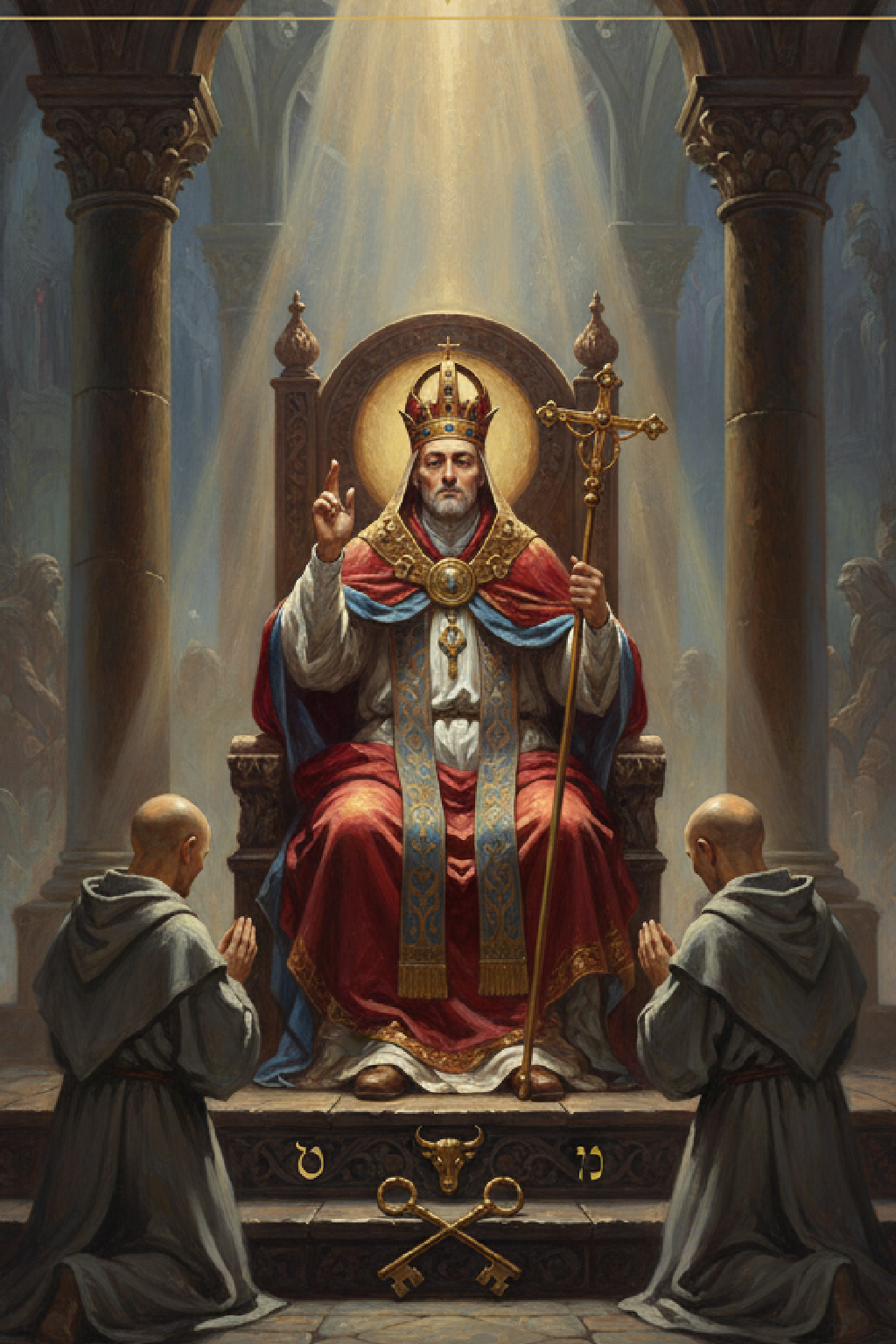
The card shows a papal figure in triple crown enthroned between two pillars, one hand raised in blessing, two tonsured monks kneeling before him, crossed keys at his feet.
Upright Meaning
When The Hierophant appears upright, you are called to engage with tradition - as student, teacher, or both. This may mean seeking a mentor, joining a spiritual community, or transmitting to others what you have received. The question is not whether tradition is valuable (it is), but which traditions deserve your allegiance.
In practical terms, this card indicates conventional approaches, established institutions, and the power of blessing - official recognition, sanctification, the stamp of approval that comes from legitimate authority. Marriage ceremonies, graduations, initiations, and other rites of passage are indicated.
The Taurus influence brings stability, patience, and the long view. What is built slowly, built well, endures. The Hierophant asks you to consider what has stood the test of time, what wisdom your ancestors gathered, what practices have been refined over generations.
Esoterically, The Hierophant represents the inner teacher who knows which tradition is right for you and when. He is the still, small voice that recognizes truth regardless of its packaging. He asks: What is your practice? Who are your teachers? What will you transmit to those who come after?
This is a card of orthodox paths - not because they are the only paths, but because they have proven their capacity to guide seekers to realization. The Hierophant respects innovation but knows that most "new" ideas are old ideas forgotten.
Reversed and Shadow Meaning
The Hierophant reversed reveals distortions of tradition, teaching, and spiritual authority.
Dogma: the letter that kills rather than the spirit that gives life. Tradition become prison rather than path. The fundamentalist who has mistaken the finger pointing at the moon for the moon itself.
False teaching: the guru who exploits students, the institution that has lost its founding vision, the church more interested in power than salvation. Spiritual materialism and corruption.
Blind rebellion: rejecting all tradition simply because it is tradition, unable to distinguish living transmission from dead ritual. The spiritual dilettante who studies everything, commits to nothing.
Inappropriately orthodox: applying traditional forms to situations that require innovation. Using the authority of the past to shut down evolution. The institution that cannot adapt.
Inappropriately heterodox: rejecting helpful structure, inventing from scratch what generations have refined, preferring personal opinion to tested wisdom.
Spiritual bypassing through tradition: using religious practice to avoid psychological work, confusing ritual observance with genuine transformation.
Golden Dawn shadow: the 16th Path blocked - Wisdom cannot reach Mercy. The teacher who has no compassion. The tradition that has become cruel.
Ask yourself: Where do I need the container of tradition, and where has tradition become my prison? Am I a genuine seeker or a spiritual shopper? Do I honor my teachers?
Esoteric Foundations
The Hierophant is Vav, the Hebrew letter meaning "nail" or "hook" - that which joins things together, connecting heaven and earth, inner and outer, the individual and the tradition. The 16th Path connects Chokmah (Wisdom) to Chesed (Mercy), bringing archetypal wisdom into manifest compassion through the vehicle of teaching and tradition.
In Crowley's Thoth deck, The Hierophant sits in the lotus position (suggesting Eastern wisdom traditions) surrounded by the four Cherubim (Lion, Eagle, Man, Bull - the fixed signs of the zodiac). He holds the triple scepter of spiritual sovereignty and makes the blessing gesture of the "nail" (two fingers raised, two lowered). Behind him, the Oriel window shows a sacred child, and at his feet, a woman holds the crescent moon - suggesting the inner, feminine mystery that the outer masculine form contains.
In the Rider-Waite-Smith deck, The Hierophant wears the triple crown of the Pope and holds the papal scepter. Two acolytes kneel before him, and the crossed keys of St. Peter lie at his feet. He sits between two pillars (like The Priestess), representing the manifest, exoteric form of the mysteries she guards in secret.
Both decks show the teacher, the bridge-builder, the initiator who transmits tradition from generation to generation.
Symbols and Forces
The Hierophant embodies the Hermetic Principle of Correspondence applied to human society - "As above, so below" becomes "As the temple, so the world." He represents the institutions that preserve and transmit sacred knowledge: the mystery school, the priesthood, the esoteric order, the guru-disciple relationship.
Taurus rules him - fixed earth, the stabilizing force that maintains form over time. Where Aries initiates, Taurus preserves. The bull was sacred to numerous mystery cults: Mithras slaying the bull, the Apis bull of Egypt, the Cretan Minotaur. Taurus represents the earthing of cosmic forces into stable, transmissible form.
In alchemy, The Hierophant corresponds to the Conjunction - the sacred marriage of opposites that produces something new while preserving the essence of both. He is the vessel in which the Red King and White Queen unite. He is also the secret fire of the philosophers - the inner heat that transforms without visible flame.
Psychologically, he represents the superego in its positive aspect - the internalized voice of tradition, conscience, and cultural wisdom. He is what we have received from those who came before and what we transmit to those who come after.
The nail (Vav) has a special significance in Hebrew mysticism - in the divine name YHVH (Yod-Heh-Vav-Heh), Vav connects the first Heh (supernal mother) to the final Heh (manifest daughter). It is the lightning bolt that descends the Tree of Life, the path of emanation from source to manifestation.
Myth and Context
The Hierophant is the mystagogue - the one who leads seekers into the mysteries. In the Eleusinian Mysteries, the hierophant ("one who shows the sacred things") revealed the final vision to initiates who had undergone years of preparation. What he revealed was never written down; it died with the last initiate.
In Christian tradition, he is the Pope, the Vicar of Christ, who holds the keys of Peter - the power to bind and loose, to forgive and to retain sins. He is the visible representative of invisible spiritual authority.
In Jewish tradition, he is the High Priest who entered the Holy of Holies on Yom Kippur, the only person permitted to speak the ineffable Name. He is the Cohen who preserved the mysteries through exile and dispersion.
In Eastern traditions, he is the guru (dispeller of darkness), the lama (superior mother), the roshi (old teacher). He is anyone who has received transmission and transmits in turn.
The ox or bull, his animal, represents both sacrifice (the blood that seals covenants) and patience (the slow, steady work of cultivation). In the zodiac, Taurus guards the treasures of the earth - and the hierophant guards the treasures of tradition.
He corresponds to the throat chakra (Vishuddha) - the center of speech, teaching, and transmission. He is the Word that was with God and was God, now spoken through human lips.
Integration Practice
To integrate The Hierophant, commit to a practice. Choose one traditional discipline - meditation technique, prayer form, yoga school, magical system - and practice it consistently for at least 40 days. Notice resistance, plateau, and eventual deepening.
Journaling prompt: "What traditions have formed me? What have I received that is worth transmitting? Where do I rebel against tradition - from genuine insight or mere reaction?"
Ritual practice: Create a simple daily ritual that connects you to something larger - lighting a candle, reciting a prayer, offering incense. Do it at the same time each day. Feel yourself joining the countless others who have performed similar acts across time.
Study: Choose one sacred text or teaching tradition and study it deeply rather than sampling many superficially. Let one path reveal its depth before moving to another.
Transmission: If you have knowledge worth sharing, find a way to teach it. Teaching crystallizes understanding and completes the cycle of reception.
Embodied practice: Visit a sacred site - church, temple, stone circle, sacred grove. Feel the accumulated intention of generations of seekers. Let that inheritance inform your own practice.
Teacher meditation: Visualize all the teachers who have brought you to your current understanding - personal teachers, authors, ancestors. Feel the lineage that flows through you. Offer gratitude. Ask for guidance on what to do with what you have received.
Ask your own question
Readings, sound healing and the sacred calendar await in the Ouracle sanctuary. Free for 14 days.
Draw a tarot spread