The Hanged Man
The Spirit of the Mighty Waters
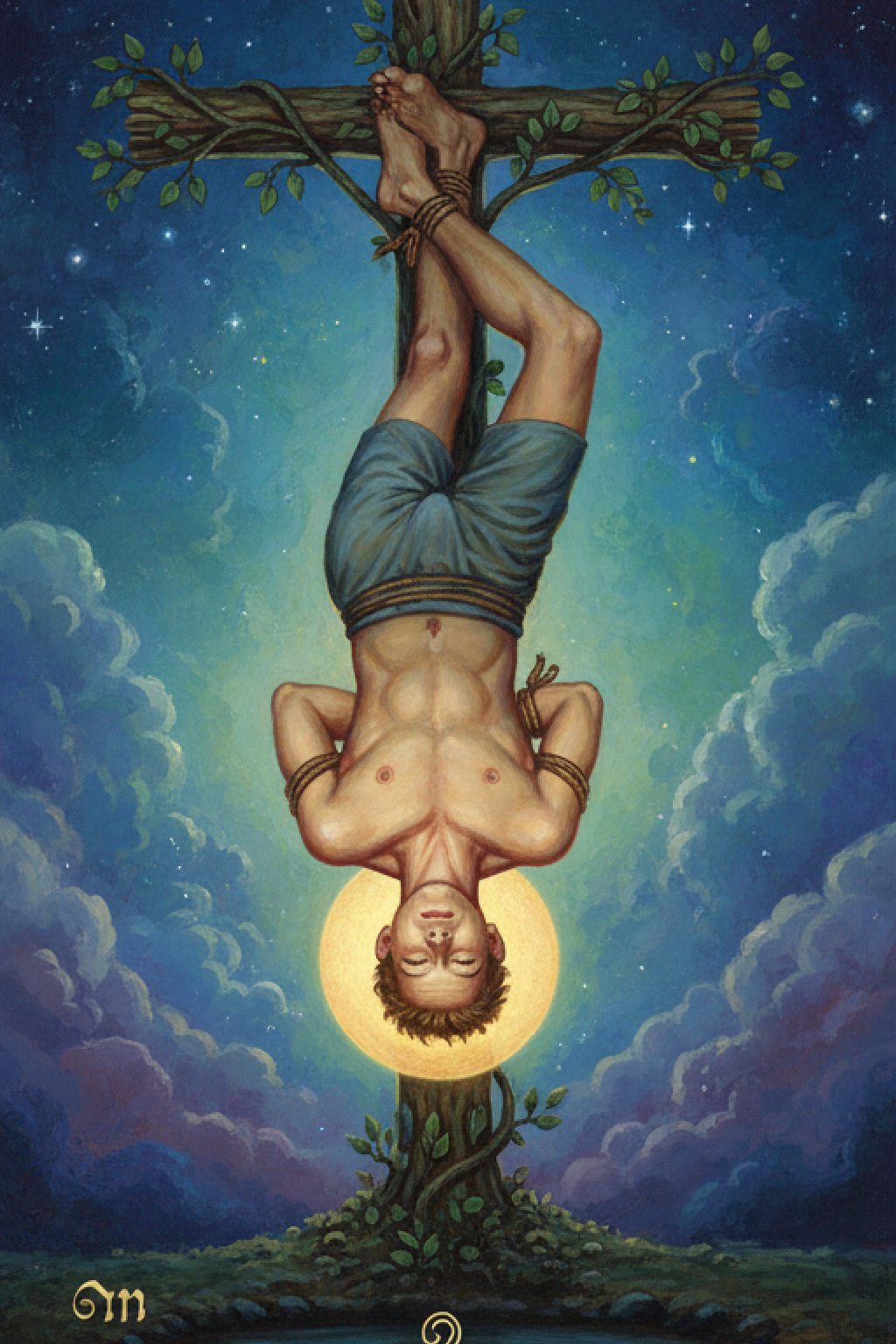
- Arcana
- Major Arcana, card 12
- Element
- Water
- Hebrew letter
- Mem (מ)
- Sephirah
- Geburah to Hod
- Path
- 23rd Path on the Tree of Life
- Alchemical stage
- Dissolution
The Scene on the Card
The card shows a young man suspended upside-down by one foot from a living green T-cross, hands behind his back, a golden halo about his head, his face at peace.
Upright Meaning
When The Hanged Man appears upright, you are called to stop, wait, and allow a shift in perspective. This is not the time for action but for contemplation. What you have been doing is not working; try not-doing.
In practical terms, this card indicates delays that serve a purpose, sacrifice that leads to gain, and the need to see a situation from a radically different angle. Let go of control. Accept the pause.
The Water influence brings intuition, emotion, and the capacity to flow rather than force. Your rational strategies have reached their limit. Let the unconscious offer its wisdom.
Esoterically, The Hanged Man often indicates a spiritual initiation that requires surrender. The ego must die to something for the Self to be born. This death is not destruction but transformation.
This card asks: What am I holding onto that I need to release? What perspective am I defending that prevents new seeing? What would happen if I stopped fighting and simply allowed?
Reversed and Shadow Meaning
The Hanged Man reversed reveals distortions of surrender, waiting, and reversal.
Stalling: using "waiting for the right moment" as excuse for fear. Paralysis disguised as wisdom. The pause that never ends.
Martyrdom: suffering that serves no transformation, sacrifice without purpose, hanging that is punishment rather than initiation.
Inability to let go: clinging to control, refusing to surrender, fighting the very process that would liberate.
Wasted suffering: pain without learning, difficulty without development. The hanged man who never sees from new perspective.
Spiritual bypass: claiming to be "above" practical concerns when actually avoiding them. Pseudo-transcendence.
Stuck upside-down: the reversal that was meant to be temporary becoming permanent. Inversion without re-integration.
Golden Dawn shadow: the 23rd Path blocked - Severity cannot reach Splendor. Discipline cannot find its intellectual expression. Effort that doesn't produce insight.
Ask yourself: Am I genuinely surrendering or just giving up? Is my waiting purposeful or merely stuck? What new perspective is available if I truly let go?
Esoteric Foundations
The Hanged Man is Mem, one of the three "mother letters" representing elemental Water. The 23rd Path connects Geburah (Severity) to Hod (Splendor), bringing martial discipline into the watery realm of intellect through radical surrender. This is not punishment but initiation.
In Crowley's Thoth deck, the figure hangs from an ankh (life) by one foot, perfectly relaxed. Serpents emerge from his head (awakened kundalini). The ankh transforms the cross (suffering) into the key of life. Green light emanates from him - new growth through apparent death.
In the Rider-Waite-Smith deck, a young man hangs upside-down from a T-cross, one leg crossed behind the other (the number 4, stability). His expression is peaceful, serene. A halo surrounds his head. He is not suffering but contemplating.
Both decks show that some truths can only be seen from an inverted perspective - that what the world calls progress is sometimes regression, and what appears to be defeat is victory.
Symbols and Forces
The Hanged Man embodies a reversal of the Hermetic Principle of Rhythm - deliberately choosing to be at the bottom of the swing, not fighting for the top. This is wu wei, the Taoist non-action that accomplishes more than action. This is Christ on the cross, Odin on the World Tree, every god who died to live.
Water is the element - formless, receptive, flowing around obstacles rather than through them. Water seeks the lowest place, and in doing so nourishes all things. The Hanged Man practices the wisdom of water.
In alchemy, this is the operation of dissolution (solutio) - the fixed forms built in earlier stages are dissolved in water, returning to prima materia so that recombination can occur. The alchemist cannot rush this stage; the matter must dissolve completely.
Psychologically, The Hanged Man represents the suspension of ego agendas, the willingness to not-know, to wait, to let larger processes unfold. This is not passivity but active receptivity - a difficult distinction that only practice illuminates.
Odin hung on Yggdrasil for nine nights to gain the runes - wisdom that could only be attained through self-sacrifice and inverted perspective.
Myth and Context
Odin, the Norse All-Father, is the primary mythic figure behind this card. He hung himself on Yggdrasil, the World Tree, pierced by his own spear, refusing food or drink for nine nights. In that suspension between life and death, he perceived the runes - the secret wisdom of the cosmos.
Christ on the cross represents the same archetype - voluntary suffering that transforms death into resurrection, the god who dies so that others may live.
In the Greek mysteries, initiates at Eleusis underwent a symbolic death and rebirth. The Hanged Man is the moment of suspension between the old life and the new.
The Tarot tradition associates this card with the traitor Judas, who hanged himself after betraying Christ. But esoteric interpretation reverses this: Judas was the necessary sacrifice that enabled the greater sacrifice. Someone had to play the villain.
The ankh in Crowley's version connects to Osiris, who was killed and dismembered by Set, then reassembled and resurrected by Isis. Dis-memberment leads to re-memberment.
Integration Practice
To integrate The Hanged Man, practice deliberate not-doing. Choose one day when you will not initiate action - only respond when necessary, otherwise rest.
Journaling prompt: "What am I clinging to that needs to be released? What would I see if I viewed my situation from the opposite perspective? What dies in me if I truly let go?"
Ritual practice: Lie in savasana (corpse pose) for thirty minutes, consciously releasing all muscular effort. Let yourself be dead. Notice what arises when you are not doing.
Inversion practice: Literal inversions shift perspective. Practice headstands, handstands, or simply hang upside down over the edge of a bed. Notice how the world looks different.
Fasting: A day without food (if medically appropriate) teaches the surrender of bodily demands. The Hanged Man transcended hunger.
Water meditation: Sit before water - a lake, a river, the ocean. Let its movement teach you. Water finds a way without forcing.
Wait practice: When impulse arises to act, wait. Notice the urgency. Question its source. Sometimes what seems urgent is merely habitual.
Ask your own question
Readings, sound healing and the sacred calendar await in the Ouracle sanctuary. Free for 14 days.
Draw a tarot spread