The Fool
The Spirit of Aether
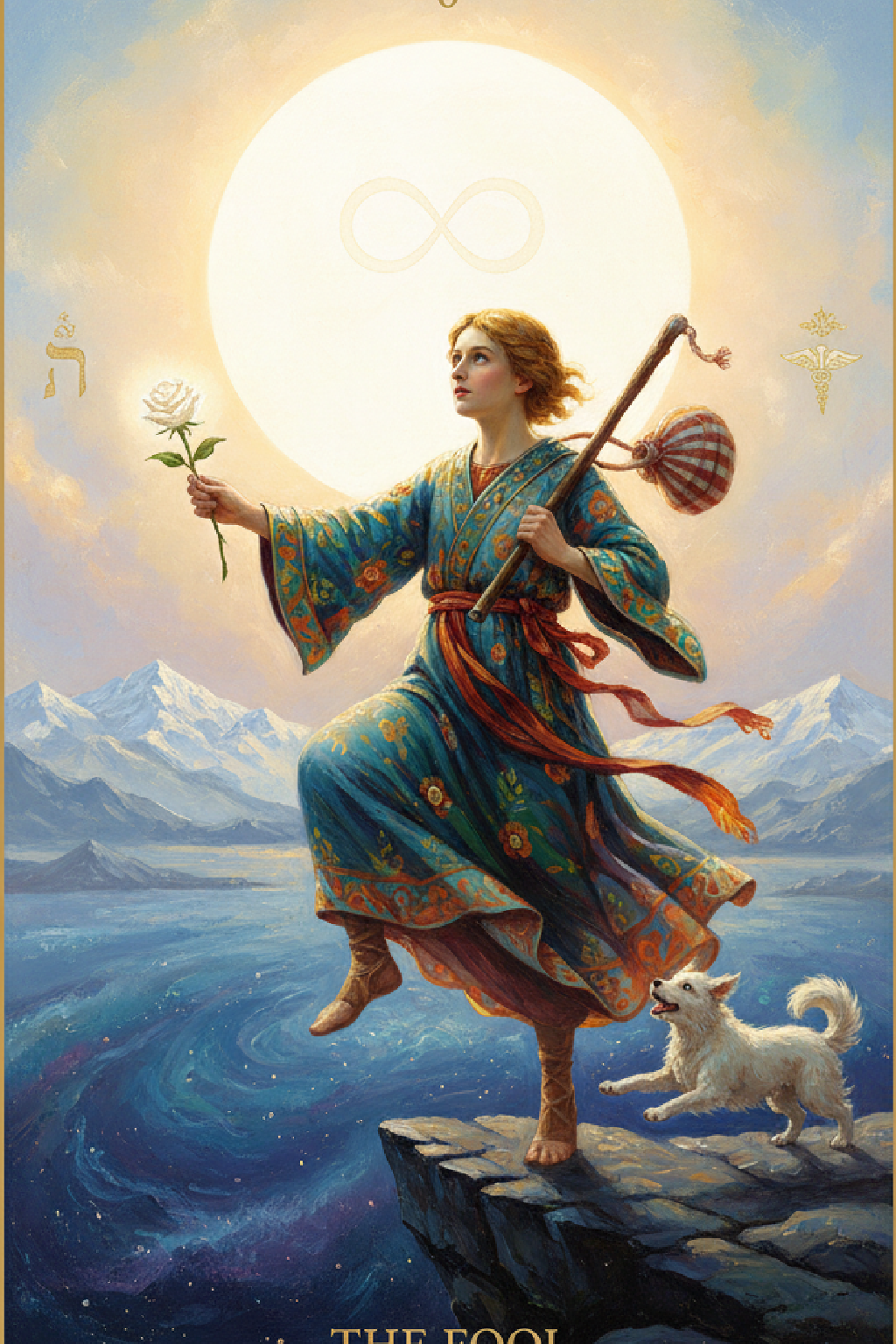
- Arcana
- Major Arcana, card 0
- Element
- Air
- Hebrew letter
- Aleph (א)
- Planet
- Uranus
- Sephirah
- Kether to Chokmah
- Path
- 11th Path on the Tree of Life
- Alchemical stage
- Prima Materia
The Scene on the Card
The card shows a young figure in bright robes stepping off a cliff edge, white rose in one hand, bundle on a stick over the shoulder, a small white dog at his heels, white sun and snow peaks behind.
Upright Meaning
When The Fool appears upright, you stand at the threshold of a genuine new beginning - not merely a fresh start in mundane terms, but a spiritual initiation into unknown territory. The universe is inviting you to step beyond the boundaries of your current understanding.
In daily life, this manifests as unexpected opportunities that require faith rather than planning, creative inspiration that defies logical explanation, or a call to adventure that your rational mind cannot justify. You may be guided to leave behind security for the sake of authentic growth.
The esoteric correspondences deepen this meaning: Uranus brings sudden awakening and liberation from crystallized patterns. Air as element speaks to new thoughts, communications, and intellectual breakthroughs. The 11th Path reminds us that this is not random chaos but the first step on the sacred journey of return to source.
The Fool's appearance often coincides with moments when you must trust intuition over evidence, faith over fear. The cliff's edge is real, but so is the ability to fly that you have not yet discovered.
Reversed and Shadow Meaning
The Fool reversed or in shadow reveals specific distortions of this archetype. Where the upright Fool transcends fear through wisdom, the shadow Fool denies fear through ignorance. This manifests as:
Recklessness without awareness - taking risks not from transcendent courage but from inability to perceive consequences. The naive assumption that "everything will work out" without engaging in the Work.
Spiritual bypassing - using "trust the universe" as an excuse to avoid practical responsibilities, emotional processing, or shadow integration. The Fool's freedom becomes escapism.
Perpetual beginning - refusing to commit to any path deeply, always starting over, never completing the alchemical stages. The prima materia remains unworked.
Refusal to learn - repeating the same mistakes without gaining wisdom. True folly is not the Fool's innocent unknowing but the stubborn refusal to integrate experience.
Golden Dawn shadow: disconnection from Kether, the crown chakra - losing touch with divine guidance while still claiming spiritual authority.
Ask yourself: Am I stepping off this cliff from wisdom or from avoidance? Is my "faith" actually trust in the divine, or denial of legitimate concerns?
Esoteric Foundations
The Fool is Aleph, the first letter of the Hebrew alphabet, numerically zero yet containing all numbers within it. In the Golden Dawn system, this card represents "The Spirit of Aether" - the divine breath (ruach) that existed before creation. The 11th Path connects Kether (Crown) to Chokmah (Wisdom), making The Fool the first emanation from the Godhead into manifestation.
In Crowley's Thoth deck, The Fool is depicted as a green figure (the "Green Man" of vegetation mysteries) holding a crystal containing the universe. He is accompanied by a tiger (symbol of fear he has transcended), a crocodile (Sebek, lord of generation), and a dove and butterfly (Venusian symbols of love and transformation). The grapes and ivy represent Dionysus, the god of divine intoxication.
In the Rider-Waite-Smith deck, the imagery is more accessible: a youth about to step off a cliff, white rose of innocence in hand, small dog at his heels (instinct and faithful companionship). The mountains behind represent the heights of attainment he will climb.
Both decks agree: The Fool is not foolish in the mundane sense. He represents the divine madness of the mystic who has transcended conventional wisdom to access higher truth.
Symbols and Forces
The Fool embodies the Hermetic Principle of Mentalism - "The All is Mind." Before differentiation into the four elements, there is pure consciousness, pure potential. This is the state before Nigredo (blackening), even before the alchemist has gathered materials for the Great Work.
Psychologically, The Fool represents the archetype of the Divine Child - innocent yet containing infinite potential. Carl Jung identified this as the Self in its most pristine form, untouched by the shadow yet containing all shadows within it.
The "holy madness" of The Fool appears across traditions: the "crazy wisdom" teachers of Tibet, the yurodivye (holy fools) of Russian Orthodoxy, the divine intoxication of Sufi mystics. This is not the foolishness of ignorance but the transcendence of conventional limitation.
Alchemically, The Fool is the prima materia itself - the undifferentiated substance from which all metals derive. The Emerald Tablet speaks of "one thing" from which all things come - this is The Fool's essence.
Myth and Context
The Fool appears across mythology as the Divine Trickster and the Sacred Clown. In Norse mythology, Loki embodies this energy - creative chaos that disrupts stagnant order. In African traditions, Eshu/Elegba guards the crossroads where all possibilities meet.
The Greek Dionysus most directly corresponds to Crowley's Fool - the god of wine, ecstasy, and divine madness who breaks down boundaries between mortal and divine. His followers (maenads and satyrs) achieved sacred frenzy that transcended ordinary consciousness.
In alchemy, the Fool corresponds to the Peacock's Tail (cauda pavonis) - the moment when the blackened matter suddenly shows all colors, indicating that transformation is possible. This is also the Mercurial Spirit - quicksilver that cannot be grasped, yet is essential to the Work.
The crocodile beneath The Fool's feet in the Thoth deck references Sobek/Sebek, the Egyptian crocodile god who represented both danger and fertility. Ammit, the "devourer of hearts," awaited in the Hall of Judgment. The Fool has transcended judgment by transcending the duality that creates karma.
In Qabalah, Aleph is the "mother letter" representing Air, positioned between Shin (Fire) and Mem (Water). It is the reconciling principle, the breath that mediates between extremes.
Integration Practice
To integrate The Fool's wisdom, begin with breath awareness - Aleph is literally "breath." Practice pranayama or simply conscious breathing, recognizing that each breath is a new beginning, a small death and rebirth.
Journaling prompt: "Where in my life am I being called to step into the unknown? What fears arise, and are they wisdom or limitation? What would I do if I truly trusted the process?"
Ritual practice: On a new moon, go to a threshold - a doorway, a crossroads, the edge of a forest. Stand there consciously, feeling the energy of possibility. Speak aloud what you are leaving behind and what you are stepping toward. Take one physical step forward and feel the shift.
Embodied exercise: Practice walking meditation with eyes slightly unfocused, allowing peripheral vision to expand. This shifts consciousness from the narrow rational focus to broader awareness, mimicking The Fool's transcendent perception.
Alchemical meditation: Visualize yourself as undifferentiated potential - no form, no identity, pure awareness. Feel the slight discomfort of having no boundaries, then feel the freedom. This is the prima materia contemplation.
Creative task: Begin something without planning it - automatic writing, spontaneous movement, improvisational art. Let yourself "not know" what you're doing and notice what emerges from that space.
Ask your own question
Readings, sound healing and the sacred calendar await in the Ouracle sanctuary. Free for 14 days.
Draw a tarot spread