Ten of Swords
Lord of Ruin
- Arcana
- Minor Arcana
- Element
- Air
- Zodiac
- Sun in Gemini
- Decan
- Third decan of Gemini (20°-30°)
- Sephirah
- Malkuth (Kingdom) in Yetzirah
- Alchemical stage
- Complete Nigredo
The Scene on the Card
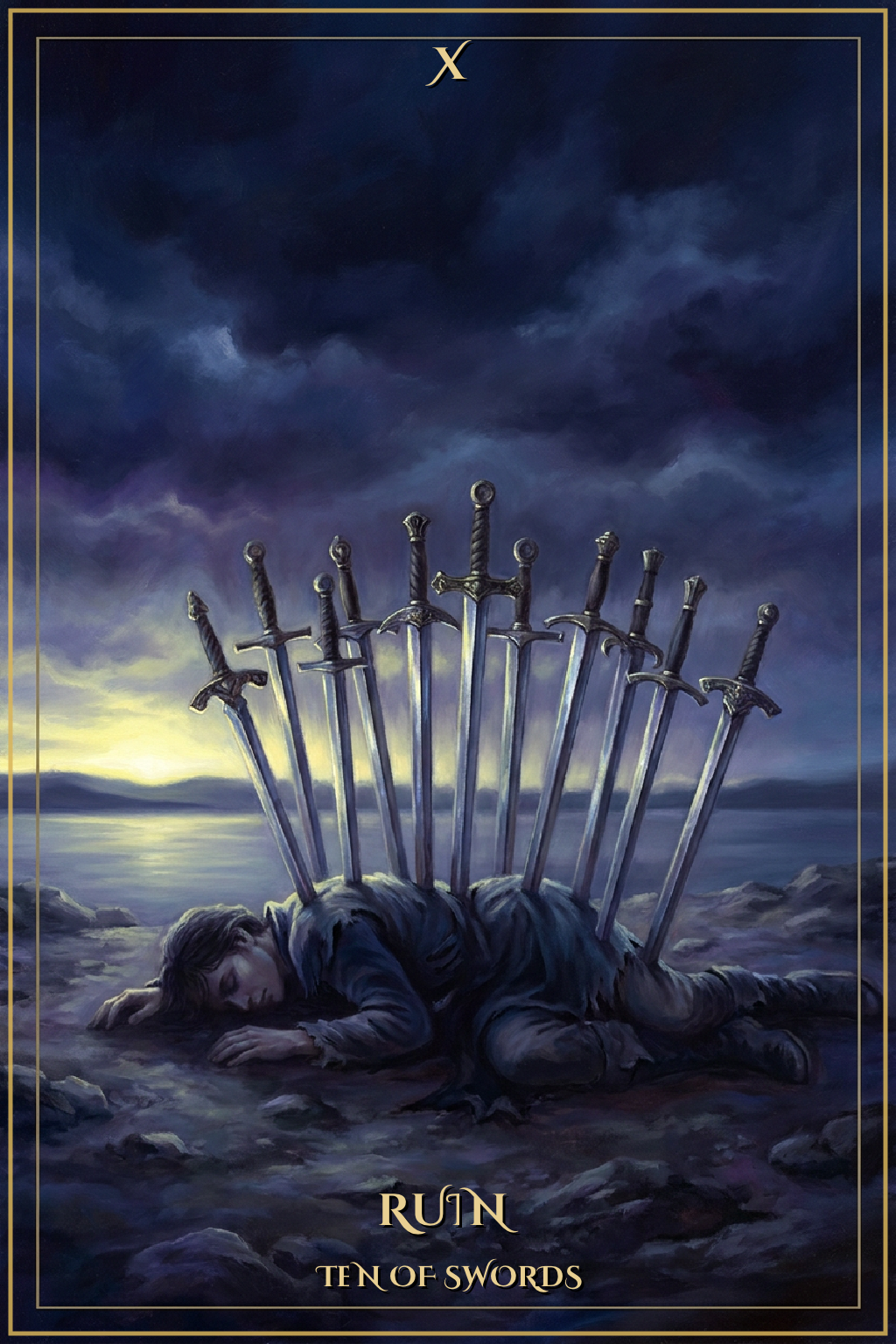
The card shows a prone figure face-down on a cold shore beneath a black sky, the first thin band of dawn on the horizon, with ten gold swords set across the upper field of the card.
Upright Meaning
When the Ten of Swords appears upright, rock bottom has been hit. The worst has happened. The attack is complete. There is a strange mercy in this: no more waiting for the other shoe to drop, no more anxiety about what might happen. It has happened.
In practical terms, this card indicates endings, betrayal, defeat, collapse of plans or relationships, and the moment when everything seems lost. It may indicate surgery, back problems, or exhaustion. Something has been killed.
The Sun in Gemini influence brings dawning awareness even to the darkest moment. You can see what happened. You can understand why. And in that understanding, you find the first glimmers of what comes next.
Esoterically, the Ten of Swords is the death that precedes resurrection. Every initiation includes a death; every transformation requires that something end. The question is not whether you will rise - you will. The question is what you will become.
This card asks: What is ending? What has been killed that needed to die? What is the golden dawn that follows this dark night?
Reversed and Shadow Meaning
The Ten of Swords reversed indicates either recovery beginning or resistance to necessary endings.
Rising: The figure stands. The swords fall away. What was dead revives. Recovery begins, slowly but surely.
Resistance to ending: Refusing to let die what needs to die. Keeping the corpse alive through denial. The ending that cannot complete.
Not quite rock bottom: There is further to fall. The worst has not yet happened. More surrender is required.
Melodrama: Treating minor setbacks as total ruin. The ten swords for what deserves two or three.
Karmic completion: The cycle truly ends. The pattern that has repeated lifetime after lifetime finally finishes.
Fear of endings: Knowing something must end but unable to let it go. The prolonged dying that prevents new life.
Ask yourself: What am I refusing to let die? What would become possible if I accepted this ending? Can I see the dawn?
Esoteric Foundations
The Ten of Swords appears catastrophic - but it is also the end of catastrophe. In the Golden Dawn, this is the "Lord of Ruin" - but in the esoteric understanding, ruin is sometimes the clearing that allows new growth. The Sun in Gemini brings light even to the darkest moment.
In Crowley's Thoth deck, ten swords pierce a heart - total destruction, complete defeat. But the image also shows the swords breaking their own points. The attack has exhausted itself. There is nowhere to go but up.
In the Rider-Waite-Smith deck, a figure lies face down with ten swords in their back, apparently dead. But look: the sky is black behind but golden on the horizon. Dawn comes. The worst has happened - and the worst is over.
Both decks show the ten as ending: the final sword has fallen, the attack is complete, and therefore something new can begin.
Symbols and Forces
The Ten of Swords embodies the Hermetic principle of Rhythm at its extreme - the pendulum has swung as far as it can go and must now return. This is the nadir, the bottom, the point from which the only direction is up.
Qabbalistically, Malkuth in Yetzirah is Kingdom expressing through the realm of mind. This is thought manifested completely in the material world - and when the thoughts have been swords, the manifestation is wounds. But Malkuth is also the Bride awaiting the King; completion promises renewal.
Sun in Gemini brings light and consciousness to the dual nature of mind. Even in apparent destruction, the solar principle offers illumination. You can see what has happened; you can understand; and in understanding, you begin to rise.
Psychologically, this card represents the moment when the crisis peaks and passes. The breakdown, the collapse, the hitting of bottom - these are endings, but also potential beginnings. What has been destroyed needed to be destroyed.
The ten as number is completion - the end of the cycle, the return to zero before the Ace begins again.
Myth and Context
The Ten of Swords is the crucifixion - the moment of apparent total defeat that is also the hinge of salvation. "It is finished" is both death cry and victory declaration.
It is Odin hanging on Yggdrasil, pierced by a spear, sacrificed to himself - the death that brings the runes, the ending that is also beginning.
In the Grail legend, this is the death of the old king that allows the new king to arise - the Fisher King finally released from his wound.
Sun in Gemini promises that light follows darkness as surely as the sun rises. The golden sky on the horizon is not metaphor but prophecy.
The face-down position of the RWS figure is significant: he cannot see the dawn. But we can. And soon, he will rise.
Integration Practice
To integrate the Ten of Swords, allow the death. Stop fighting the ending. Let what must die, die.
Journaling prompt: "What is really ending here? What needed to die? What becomes possible now that this has fallen?"
Funeral ritual: Mark the ending. Bury it, burn it, release it to water. Grief the loss fully so that new life can come.
Dawn watching: Literally watch a sunrise. Let the physical event teach you about spiritual cycles. Darkness ends.
Inventory of swords: Which of these swords were necessary? Which wounds taught you? Not all pain is pointless.
Rising practice: Imagine standing up after the fall. Feel your hands pressing against the earth. Feel your spine straightening. You are not dead.
Pattern recognition: Is this a familiar ending? Have you been here before? What does finally completing this cycle make possible?
Ask your own question
Readings, sound healing and the sacred calendar await in the Ouracle sanctuary. Free for 14 days.
Draw a tarot spread