Five of Swords
Lord of Defeat
- Arcana
- Minor Arcana
- Element
- Air
- Zodiac
- Venus in Aquarius
- Decan
- First decan of Aquarius (0°-10°)
- Sephirah
- Geburah (Severity) in Yetzirah
- Alchemical stage
- Separatio's violence
The Scene on the Card
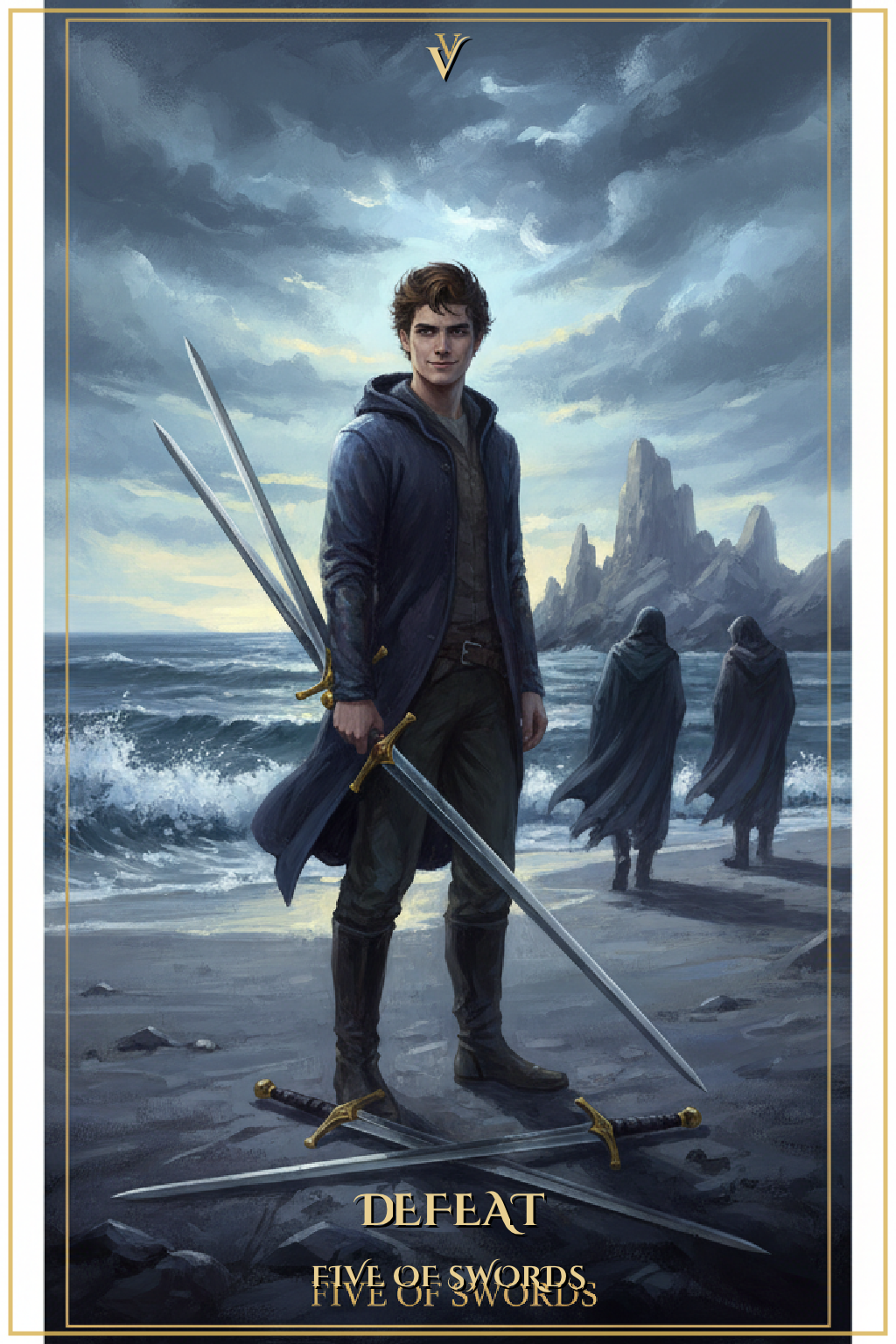
The card shows a smirking victor on a windswept shore watching two beaten figures walk away beneath torn clouds, with five gold swords set across the upper field of the card.
Upright Meaning
When the Five of Swords appears upright, conflict has escalated beyond productive tension into destructive aggression. Someone is "winning" but everyone is losing. This may be you wielding the swords or you walking away defeated.
In practical terms, this card indicates arguments that have gone too far, victories that feel hollow, bullying or being bullied, intellectual aggression, and the aftermath of fights where no one truly wins.
The Venus in Aquarius influence brings emotional investment hidden behind intellectual posturing. The fight may seem to be about principles, but it is really about love - love wounded, love denied, love that has become its opposite.
Esoterically, the Five of Swords warns against the ego's endless need to be right. The swords have defeated their purpose when they destroy what they were meant to protect.
This card asks: What has your victory cost? Is being right worth being alone? Can you walk away from a fight you would win?
Reversed and Shadow Meaning
The Five of Swords reversed indicates the aftermath of defeat or the possibility of resolution.
Accepting loss: The fight is over. You have lost. Now what? Humiliation may teach what victory could not.
Releasing the need to win: Perhaps the conflict was not worth having. Perhaps being right matters less than being connected.
Regret for cruelty: If you were the victor who cut too deeply, remorse may now arrive. Was it worth it?
Ongoing resentment: Defeat that has not been processed, humiliation that festers into plans for revenge.
Reconciliation possible: The swords are lowered. Perhaps what was damaged can be repaired. Perhaps apology is possible.
Self-defeat: The worst enemy was yourself. The swords you wielded against others turned on you.
Ask yourself: What did this conflict cost? What would forgiveness look like? Was winning worth the price?
Esoteric Foundations
The Five of Swords is one of the most troubling cards in the deck. In the Golden Dawn, this is the "Lord of Defeat" - and defeat here is multi-layered: the defeated, the apparent victor who has won nothing worth having, and the observers who must live with the aftermath.
In Crowley's Thoth deck, five swords are arranged in an inverted pentagram - spirit inverted, matter triumphant in the wrong way. The blades are bent, twisted, damaged by the conflict. Even the weapons have been diminished.
In the Rider-Waite-Smith deck, a smirking figure holds three swords while two others walk away dejected. He has "won" - but won what? He stands alone with his trophies while relationship lies in ruins.
Venus in Aquarius places love and beauty in the sign of abstract idealism - and the result is love that becomes ideology, connection sacrificed to being right.
Symbols and Forces
The Five of Swords embodies the shadow of the Hermetic principle of Polarity - not the creative tension of opposites but the destructive conflict that leaves both sides diminished.
Qabbalistically, Geburah in Yetzirah is Severity expressing through the realm of mind. Geburah is Mars, the warrior energy - but here it has exceeded its proper bounds. The surgery has become butchery.
Venus in Aquarius creates a peculiar cruelty - the cold ideological violence that thinks it is serving a higher purpose, the intellectual aggression that destroys relationship in the name of principle.
Psychologically, this is the pyrrhic victory - winning the argument while losing the connection, being right while being alone. It is also the experience of being defeated, not by fair means, by someone who did not deserve to win.
The five as number is disruption, conflict, the instability that breaks the four's peace. In Swords, this disruption cuts deep.
Myth and Context
The Five of Swords is Pyrrhus after Asculum - "Another such victory and I am undone." The king who won the battle but lost so many soldiers that the war was lost.
It is Achilles in his tent after dragging Hector's body - the greatest warrior reduced to petty cruelty, dishonoring himself in dishonoring his enemy.
In the Norse tradition, this is the aftermath of Ragnarök - the gods have won, but the world is destroyed. Victory and defeat have become indistinguishable.
Venus in Aquarius echoes the coldness of ideology that sacrifices human connection for abstract principle - the revolutionary who destroys love in the name of loving humanity.
The smirking victor in the RWS deck will go home alone. His triumph is complete and empty.
Integration Practice
To integrate the Five of Swords, examine your relationship with winning and losing.
Journaling prompt: "What did my last 'victory' cost? What would I lose by being wrong? Why do I need to win?"
Humility practice: Deliberately lose an argument. Agree when you could debate. Notice what it costs you - and what it gives.
Forgiveness work: If you have been defeated cruelly, work to release the resentment. Not for them but for you. The swords in your heart are yours to remove.
Amends: If you have been the victor who cut too deeply, consider amends. What would repair look like?
Walking away: Practice leaving conflicts you could win. Notice how much energy becomes available when you stop fighting.
Venus in Aquarius work: Where have your ideals become weapons? Where does being right prevent you from being loving?
Ask your own question
Readings, sound healing and the sacred calendar await in the Ouracle sanctuary. Free for 14 days.
Draw a tarot spread